
Home › The BuaFlow Blog › Co-Parenting
Co-ParentingHoliday parenting schedule: a calm plan for separated parents, with Nevada notes
Thanksgiving is a month away and winter break follows fast. Here's how to read the schedule you already have, compare the common ways families split holidays, and put the details in writing before the first handoff.

Key facts at a glance
- Nevada wants specifics: Under NRS 125C.010, a Nevada order awarding visitation must define it "with sufficient particularity" to be enforced, including specific times, rather than terms like "reasonable."
- CCSD dates for 2026–27: No school Thursday–Friday, November 26–27, 2026 for Thanksgiving; winter break runs December 21, 2026 through January 4, 2027, with students back Tuesday, January 5 (CCSD student calendar, marked subject to change).
- Lots of families do this: About one in four U.S. children under 21 lived with only one parent in 2022, per the U.S. Census Bureau (August 2025).
- Conflict is the risk, not the calendar: A 2020 meta-analysis of 115 samples and 24,854 divorced families linked interparental conflict to more child adjustment problems, partly through how parents behave with their kids (Clinical Psychology Review).
- Clark County help exists: The court's Family Mediation Center helps parents who are ordered to mediation reach agreements on custody, timeshare, holidays, vacation and transportation.
A holiday parenting schedule is the part of a parenting plan that tells both households who has the kids on Thanksgiving, winter break, birthdays and the other days that matter to your family. When it's clear, holidays mostly take care of themselves. When it's vague, the same argument tends to come back every November.
This guide is for separated and divorced parents who want fewer surprises this season. It walks through how to read the plan you already have, the common ways families divide holidays, a comparison table, sample wording and a short checklist, plus a few notes for Las Vegas and Nevada families. It's general information, not legal advice. If you have a court order, it controls, and a family-law attorney can tell you how it applies to you.
What is a holiday parenting schedule?
Most parenting plans have three layers that stack on top of each other:
- The regular schedule. The week-to-week pattern, such as alternating weekends or a 2-2-3 rotation.
- Vacation time. Longer blocks, often in summer, that each parent can claim with notice.
- The holiday schedule. Specific days that override the regular pattern, like Thanksgiving, winter break, Mother's Day and Father's Day, birthdays and religious holidays.
Many plans say the holiday schedule takes priority over vacation time, and vacation time takes priority over the regular schedule. Las Vegas family-law firm Rosenblum Allen describes that order as typical in its Nevada holiday custody guide (updated July 2026). Your plan may say something different, so check its wording rather than assuming.
The practical question for each holiday is simple: on that day, does the regular schedule pause, and if so, for exactly how long?
How do you read the holiday section of your parenting plan?
Before you text the other parent about Thanksgiving, sit down with your plan or order and a calendar for 15 minutes. Look for these details and write down what it actually says:
- Which holidays are listed. Anything not listed usually follows the regular schedule.
- Odd or even years. Many plans assign a holiday to one parent in odd-numbered years and the other in even years. 2026 is an even year.
- Start and end times. "Thanksgiving" can mean Thursday morning to Thursday night, or Wednesday after school through Sunday evening. The difference is three days.
- How breaks are defined. Does winter break start when school lets out, or on a set date? Is it split at a midpoint, and how is that midpoint calculated?
- Exchange location and transportation. Who drives, and where does the handoff happen?
- What happens afterward. Does the regular schedule resume exactly where it would have been, or restart?
- Travel and notice rules. Some plans require advance notice or an itinerary for out-of-town trips.
If any of these are missing, that's normal. It just means you and the other parent need to agree on the detail in writing, or ask your attorney how to handle it.
Most holiday fights aren't really about the holiday. They're about an unanswered question, like what time "Christmas Eve" starts, that both parents filled in differently. Reading the plan early and naming the gaps calmly, weeks ahead, takes most of the heat out of it.
What are the most common ways to split holidays?
There's no single right structure. Families usually choose based on how far apart the homes are, the children's ages, religious and family traditions, and how well the parents can coordinate. These are the approaches you'll see most often:
Alternating by year
One parent has Thanksgiving in even years and the other in odd years, with a similar rotation for other holidays. It's simple to remember and gives each child a full holiday in one home. The trade-off is that a parent goes a full year without that holiday.
Splitting the day
The children spend part of the holiday with each parent, for example Christmas Eve with one and Christmas Day with the other, or morning and afternoon on Thanksgiving. Both parents see the kids every year, but it means more exchanges and can turn the day into a drive. It tends to work best when the homes are close.
Splitting the break
Longer breaks, especially winter break, are divided into two blocks, often with the halves alternating each year so neither parent always gets Christmas Day. This gives each household real downtime instead of a rushed afternoon.
Fixed holidays
Some days stay with the same parent every year. Mother's Day and Father's Day are common examples, as are religious holidays that only one parent observes. Fixed holidays can reduce negotiation, as long as the overall split still feels fair.
Celebrating twice
Some families hold a second celebration on a different day, such as "Friday Thanksgiving." Children often enjoy two celebrations more than a hurried one, especially when travel is involved.
Holiday schedule options compared
| Approach | How it works | Often works well when | Watch out for |
|---|---|---|---|
| Alternating by year | Odd years with one parent, even years with the other | Homes are far apart or families travel | A full year without that holiday for one parent |
| Split day | Morning with one parent, afternoon or evening with the other | Homes are a short drive apart; younger children | Extra exchanges; long drives eating the holiday |
| Split break | First half and second half of a break, often alternating yearly | Winter break and spring break | Unclear midpoints; who gets Christmas Day |
| Fixed holidays | Same parent every year for certain days | Mother's Day, Father's Day, one parent's religious holidays | An uneven total over the year |
| Celebrate twice | A second celebration on another day | Extended family events, travel years | Kids feeling over-scheduled |
Whichever structure you use, the details carry the load: exact times, the exchange spot, and what happens if a flight is delayed or a child is sick.

Why does Nevada care so much about specific times?
Nevada law leans toward specifics. NRS 125C.010 says an order awarding visitation must define it "with sufficient particularity" so the parties' rights can be properly enforced and the child's best interest is served, and it must include the specific times and other terms. The statute defines sufficient particularity as stating rights in absolute terms, not with words like "reasonable" that each parent could read differently.
That's useful even if you never set foot in a courtroom. A holiday line that says "the children will be with Mother from Wednesday, November 25 at 5:00 p.m. until Friday, November 27 at 5:00 p.m., with exchange at Mother's home" leaves very little to argue about. A line that says "the parties will share Thanksgiving" leaves almost everything.
If your existing order is vague and the two of you can't agree, that's a question for a family-law attorney or the court, not something to settle by text at 9 p.m. on Thanksgiving Eve.
What are the key school-break dates for Clark County families in 2026–27?
Many parenting plans tie holidays to the school calendar. For Clark County School District families, the 2026–27 student calendar (dated September 4, 2025 and marked "subject to change") lists:
- Nevada Day: no school Friday, October 30, 2026.
- Veterans Day: no school Wednesday, November 11, 2026.
- Thanksgiving: no school Thursday and Friday, November 26–27, 2026.
- Winter break: school lets out at the end of the day Friday, December 18; no school December 21 through January 1; Monday, January 4, 2027 is a staff development day; students return Tuesday, January 5, 2027.
- Spring break: no school March 15–19, 2027, with classes resuming Monday, March 22.
Two things trip families up here. First, if your plan says winter break "begins when school is released," that's Friday, December 18 after school, not Monday the 21st. Second, a staff development day like January 4 is a day off for students; check whether your plan counts it as part of the break. Charter, private and out-of-district schools follow their own calendars, so confirm with your child's school.
Also worth noting for 2026: Hanukkah falls in early December this year (December 4–12 on Chabad's calendar), well before winter break. If your family observes it, decide which nights are with which parent rather than assuming it rolls into the break.
Put the real dates on one shared calendar this week: Thanksgiving, the winter-break start and end times, the midpoint if you split it, and every exchange. Then send one short message confirming them. A plan you both looked at in October is far easier to follow than one you discover in December.
How do you write holiday terms that leave less room for conflict?
Whether you're drafting a plan with an attorney, preparing for mediation or just confirming this year's arrangement, clear wording follows the same pattern: holiday, parent, start, end, place, and what happens next. Here's sample language to show the level of detail. Adapt it with your attorney; it isn't a form.
"Thanksgiving: In even-numbered years, the children will be with [Parent A] from Wednesday at 5:00 p.m. until Friday at 5:00 p.m. In odd-numbered years, the children will be with [Parent B] for the same period. Exchanges take place at [location]. The regular schedule resumes Friday at 5:00 p.m."
"Winter break: Winter break begins when school is released for the break and ends at 5:00 p.m. the day before school resumes. The break is divided at noon on [date]. [Parent A] has the first half in even-numbered years; [Parent B] has the first half in odd-numbered years."
And for the message you send the other parent about this year, short and factual works best:
"Hi [Name], confirming Thanksgiving under our plan: the kids are with me Wednesday 11/25 at 5 p.m. through Friday 11/27 at 5 p.m., exchange at my place. Does that match your calendar?"
Notice what's not there: no history, no blame, no extra opinions. One question, one confirmation.
How do you handle travel, family visits and video calls?
Holidays are when trips happen, and trips are when plans get tested. A few habits help:
- Share the itinerary early. Flight times, where the children will stay and a phone number where they can be reached. Many plans require this; it's good practice even when they don't.
- Agree on a delay rule. Decide in advance what happens if a flight is late: does the exchange move to the next morning, or does the time get made up later?
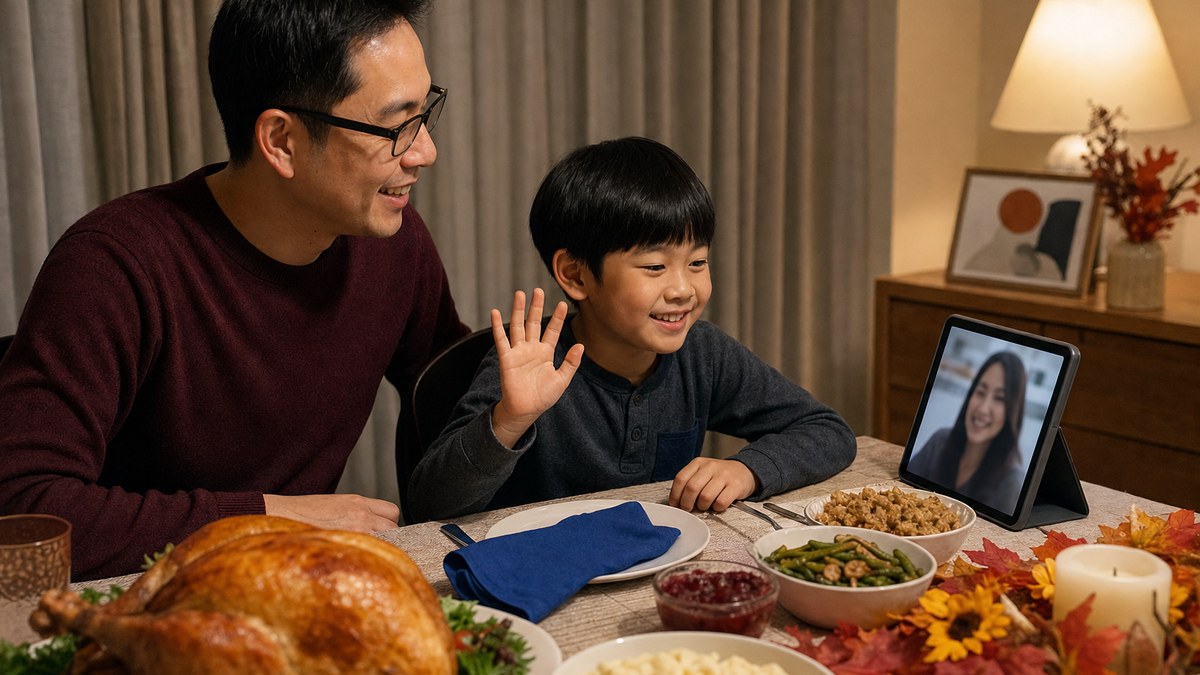
- Plan the call. If the children will be away from one parent on the holiday, set a time for a short phone or video call so it isn't a surprise in the middle of dinner.
- Keep grandparents in the loop, not in the middle. Extended family can be a big part of holidays. Arrangements still go parent to parent.
The American Academy of Pediatrics noted in its December 2016 clinical report on divorce and separation, published in Pediatrics, that children's sense of loss can resurface around holidays and special events, and that keeping daily life as stable as possible helps. A predictable schedule, a planned call and a calm handoff all serve that goal.
What should you do if you and the other parent can't agree?
Start with the order. If it clearly answers the question, follow it; an existing order generally stays in effect until a court changes it. If it doesn't, try one calm, written proposal with two options and a deadline that's comfortably before the holiday.
If that doesn't work, Clark County has resources built for this:
- Family Mediation Center (FMC). The Eighth Judicial District Court's Family Mediation Center provides confidential mediation for non-financial custody disputes, helping parents reach agreements on legal custody, timeshare, holidays, vacation and transportation. Access requires a court order, fees are on a sliding scale based on income (and may be waived for people on public assistance), and an agreement isn't a court order until a judge signs and files it. It's at the Family Court and Services Center, 601 North Pecos Road, Las Vegas.
- Family Law Self-Help Center. The court-affiliated Family Law Self-Help Center helps self-represented parents find the right forms, including guided interviews for a motion to modify custody or visitation. It doesn't give legal advice. The court lists its phone number as 702-455-1500.
- A family-law attorney. For anything that involves changing an order, relocation, or a disagreement about what the order means, an attorney can advise you on your specific situation.
If you're ever worried about safety, for yourself or your children, that comes before any schedule. Call 911 in an emergency. The National Domestic Violence Hotline is available at 1-800-799-7233.
Why keeping kids out of the middle matters most
Research consistently points to conflict, not the schedule itself, as the thing that weighs on children. A 2020 meta-analysis in Clinical Psychology Review by Rianne van Dijk, Inge van der Valk, Maja Deković and Susan Branje pooled 115 samples covering 24,854 divorced families. It found that interparental conflict was linked to children's adjustment problems, with the effects small but consistent, and that part of the link ran through parenting behaviors such as hostility and "role diffusion," where children end up in an adult role between their parents.
In holiday terms, that looks like a few simple rules:
- Don't use the children to carry messages about the schedule.
- Don't ask them to choose where they'd rather be on the holiday unless your plan and their age make that appropriate.
- Keep exchanges short and friendly, even when you're frustrated.
- Let them enjoy the other household's traditions without guilt.
You won't get every holiday right. Very few families do. A clear plan just means the hard conversations happen between adults, ahead of time, instead of in the driveway.
A calm text sent three weeks early does more for a holiday than a perfect argument sent the night before. That's the thinking behind CoParent Pro: short, neutral messages and one shared place for schedules, so both homes are working from the same page.
Get the free 10 Calm Message Starters
Ten short, neutral templates for schedule changes, holiday confirmations, expenses and school updates, plus a quick do-and-don't guide. Join the CoParent Pro list and download the 2-page PDF instantly. CoParent Pro is BuaFlow's co-parenting system: message templates, a shared parenting organizer and structured communication lessons.
Download the free 10 Calm Message StartersA holiday planning checklist for separated parents
- Read the holiday section of your plan or order and note what it says for each holiday this year (2026 is an even year).
- Write the exact dates and times for Thanksgiving and winter break on one calendar, using your child's school calendar.
- Mark every exchange: time, place and who drives.
- Send one short message confirming the dates. Save the reply.
- Share any travel plans and itineraries early.
- Agree on a time for holiday calls or video chats.
- Decide what happens if someone is sick or a flight is delayed.
- Note anything your plan doesn't cover and ask your attorney or use mediation well before the holiday.
Frequently asked questions
What is a holiday parenting schedule?
It's the part of a parenting plan that sets who has the children on specific holidays and school breaks, and for exactly how long. It usually overrides the regular weekly schedule for those days.
How do most parents split Thanksgiving?
Common approaches are alternating Thanksgiving by odd and even years, splitting the day between households, or giving one parent Thanksgiving Day and the other the rest of the weekend. The right choice depends on distance, the children's ages and family traditions, and your order controls if you have one.
How is winter break usually divided?
Many families split it into two halves and alternate which parent gets the first half each year, so Christmas Day rotates. Define the start, the midpoint and the end with dates and times, and check how your child's school defines the break.
When is Thanksgiving break for CCSD in 2026?
The Clark County School District 2026–27 student calendar shows no school on Thursday and Friday, November 26–27, 2026. The calendar is marked subject to change, so confirm with your school.
When does winter break start and end for CCSD in 2026–27?
Per the CCSD student calendar, school lets out at the end of the day Friday, December 18, 2026, there's no school December 21 through January 1, January 4 is a staff development day, and students return Tuesday, January 5, 2027.
Does Nevada law require specific holiday times in a custody order?
NRS 125C.010 requires an order awarding visitation to define it with sufficient particularity to be enforced, including specific times and other terms, rather than words like "reasonable." Ask a Nevada family-law attorney how that applies to your order.
Can we change the holiday schedule if we both agree?
Parents often agree on one-time swaps in writing. A lasting change to a court order generally requires the court's approval, so talk to an attorney or the Family Law Self-Help Center about modifying an order.
What if the other parent won't follow the holiday schedule?
Stay calm, keep the children out of it and keep written records of what was agreed and what happened. Talk to a family-law attorney about your options. If anyone is in danger, call 911.
Is there free mediation for custody disputes in Las Vegas?
The Eighth Judicial District Court's Family Mediation Center handles court-ordered custody mediation, including holidays and vacations. Fees are on a sliding scale by income and may be waived for parents receiving public assistance.
Should the children decide where they spend the holiday?
Asking children to choose can put them in the middle of their parents. Some plans give older children more input; ask your attorney how your order and Nevada law treat a child's preferences.
Keep reading
Sources
- Nevada Revised Statutes NRS 125C.010: "Order awarding visitation rights must define rights with particularity," via nevada.public.law, accessed October 2026
- Clark County School District: "2026-2027 School Calendar for Students," dated September 4, 2025 (subject to change)
- Eighth Judicial District Court: "Family Mediation Center (FMC)," last modified May 13, 2026
- Eighth Judicial District Court: "Legal Aid Self-Help Center helps self-represented litigants remotely," August 11, 2020
- U.S. Census Bureau: "Custodial Parents and Their Child Support: 2022," Liza C. Valle, August 2025
- van Dijk, van der Valk, Deković and Branje: "A meta-analysis on interparental conflict, parenting, and child adjustment in divorced families," Clinical Psychology Review, vol. 79, July 2020
- Medical Xpress (HealthDay): "Pediatricians can help when parents divorce: report," on the American Academy of Pediatrics clinical report in Pediatrics, November 28, 2016
- Rosenblum Allen Law Firm: "Nevada Child Custody Holiday Schedule: A Parent's Guide," updated July 22, 2026
- Chabad: "Chanukah" (2026 dates listed as December 4–12), accessed October 2026
This article is general educational information, not legal advice, and it does not replace your parenting plan, court orders or advice from a licensed family-law attorney. Laws, school calendars and court procedures change; confirm current details before you act. If you or your children are in danger, call 911. The National Domestic Violence Hotline is 1-800-799-7233. Images are illustrations, not photos of real families.